How to Start a US LLC
Borderless Formation Guide
A meticulous operational textbook mapping out state jurisdiction selection, Articles of Organization filing, EIN federal tax ID procurement, internal operating agreement drafting, and compliance maintenance loops for global non-resident founders.
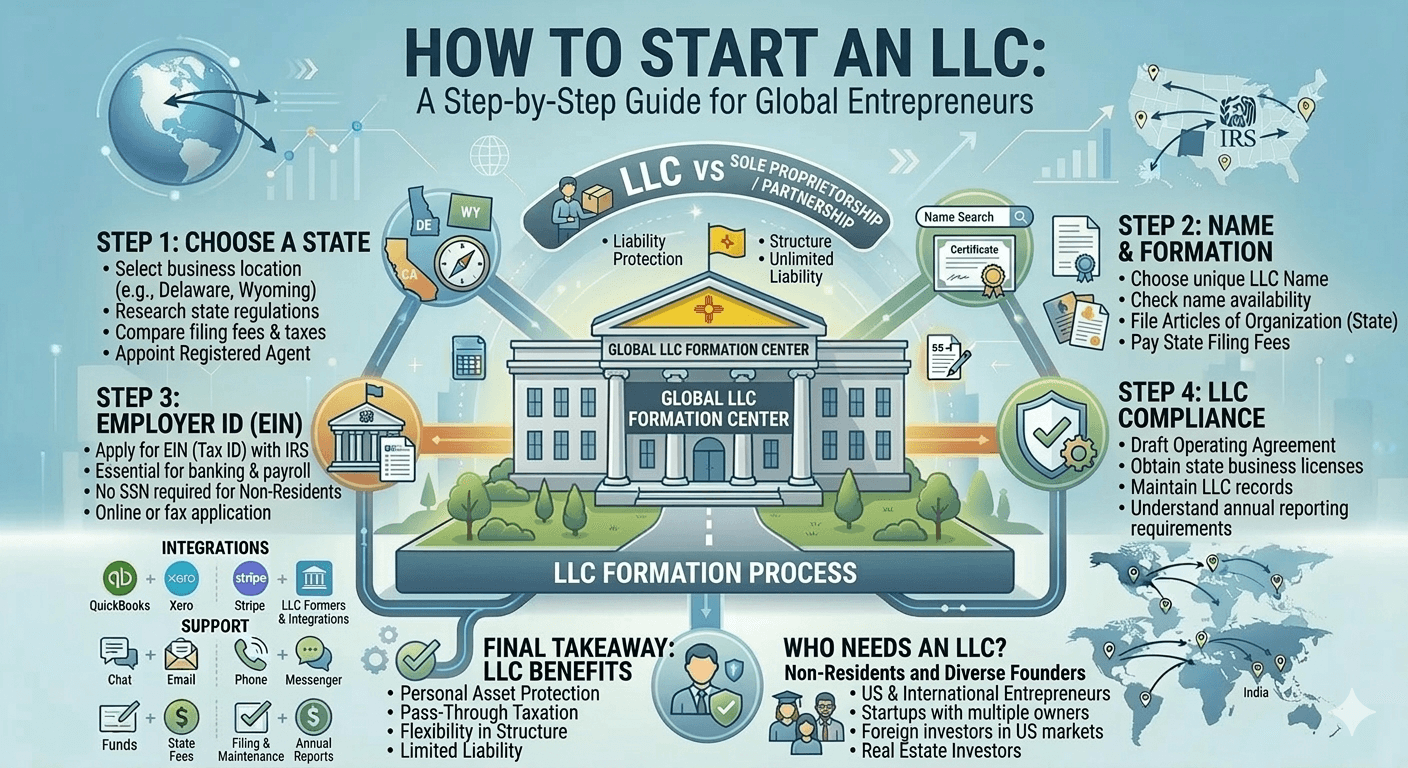
What is the structural importance of selecting a US state jurisdiction that aligns with your specific e-commerce or SaaS scaling goals?
The selection of a state jurisdiction is the primary architectural decision for any international builder. You are not simply filing paperwork; you are selecting the legal 'home' of your asset. For global non-resident founders, the selection typically bifurcates into two elite pathways: Wyoming and Delaware. Wyoming serves as the undisputed heavyweight for small-to-mid-sized digital operations, e-commerce stores, and bootstrapped software ventures due to its extremely low recurring state maintenance overhead, robust privacy statutes that keep ownership names off public databases, and highly efficient electronic filing loops. Delaware functions as the mandatory global gateway for entities targeting institutional venture capital, Series-A fundraising, or public equity listings. Its Court of Chancery offers specialized business judges and legal precedents that provide the highest level of structural predictability for institutional investors. Misaligning your state selection at formation forces founders to pay expensive domestication fees later to shift jurisdictions.
How does the 'Articles of Organization' filing process map your entity into the public index, and how can founders maintain privacy?
The Articles of Organization represent the legal birth certificate of your business node. When submitted to the Secretary of State, this file captures the entity name, principal physical address, and the designation of your Registered Agent. Because these filings are public, the data is instantly crawled by global marketing networks. To maintain absolute corporate anonymity, you must utilize a professional Registered Agent service during this initialization loop. By mapping your agent's verified commercial office address into the public principal and mailing fields, you completely obfuscate your individual non-resident residential location from public databases. This structural layer acts as a permanent privacy shield, ensuring your home coordinates never enter the public record.
What are the automated verification pipelines for an Employer Identification Number (EIN) when applying as a non-resident alien?
The Federal Employer Identification Number (EIN) is the primary engine behind your US merchant account authority. For global founders without an SSN or ITIN, the automated IRS web portal will trigger immediate session timeouts. Instead, you must deploy a manual filing pathway via Form SS-4. This involves mapping your specific 'Foreign' classification onto the federal tax node, nominating a responsible party, and routing the documentation package through specialized international IRS fax or mail channels. The IRS manually audits these files against your state-filed Articles to confirm the legitimacy of the entity before issuing the official CP575/147C validation document, which serves as your permanent identifier for all banking and tax infrastructure.
Why is an Operating Agreement legally mandatory for multi-member entities to prevent state default rule takeovers?
Operating Agreements are the sovereign constitution of your LLC. If your entity fails to produce this document, you are legally defaulting to the state's generic legislative templates. In many jurisdictions, these default rules require profits to be distributed based strictly on capital contributions, or mandate that the company must liquidate immediately if a single member drops out. A custom Operating Agreement allows founders to override these rigid defaults, enabling custom profit-sharing matrices, specific member withdrawal procedures, and specialized management roles (Member-managed vs. Manager-managed). For a borderless founder, this internal document is the single strongest asset in your defense, ensuring that any internal ownership disputes are resolved according to your specific rules rather than the generic state legislative statutes.
How do US neobanks and merchant processors audit your entity status to verify ongoing 'Good Standing' compliance?
Modern fintech banking networks like Mercury and Stripe utilize algorithmic auditing to monitor your status as a 'Good Standing' entity. Their compliance engines run periodic, automated scans against state corporate registries. If your state filing status indicates 'Dissolved', 'Delinquent', or 'Suspended' due to an unfiled annual report or a resigned Registered Agent, the financial platform's automated underwriting engine will instantly isolate your account. This causes immediate, programmatic account freezes, disabling your outbound settlement pipelines, blocking incoming customer payments, and locking you out of your global capital holdings until the structural delinquency is parsed and re-filed with the Secretary of State.
MANDATORY FORMATION PIPELINES
Essential Asset Protection
- Establishes a permanent, sovereign legal wall insulating personal holdings from business litigation.
- Enables professional federal tax ID tracking essential for all banking clearings.
- Provides official state charter documentation required by modern merchant gateway algorithms.
Borderless Operational Nodes
Registering in a premier jurisdiction allows non-residents to access the US marketplace from any global location. By utilizing a certified registered agent and cloud-native administration, you manage your firm with the structural authority of a domestic US organization.
FORMATION DATA PIPELINE NODES
Senior Formation Execution Directives
- Audit your chosen corporate name against the state index database to ensure no character collisions trigger filing delays.
- Select a certified Registered Agent with robust commercial street coordinates to maximize your public privacy shield.
- Draft an internal Operating Agreement immediately upon state approval to insulate your capital from future management litigation.
- Complete your federal FinCEN BOI (Beneficial Ownership) report within 90 days to retain corporate status standing.
Administrative Dissolution & Personal Liability Risk Matrix
Forming an LLC is a binding regulatory commitment. Neglecting to pay state maintenance fees, failing to appoint a licensed agent, or running your entity as a mere pass-through shell without internal operating records leads to legal veil piercing. In civil litigation, this entirely strips your limited liability armor, exposing all personal capital assets globally. Furthermore, state registries utilize automated dissolution protocols for inactive entities, which instantly voids your federal tax ID, locks down your banking clearings, and renders your entire corporate framework null and void in the eyes of the law.
Corporate Formation Infrastructure Audit Complete
Protocol Node Check: US LLC Initialization Architecture Certified • Last Reviewed: May 19, 2026
S4HEL Online University Independent Research Node • Outbound Routing Terminals Locked