US Business Address
Identity Foundation
A meticulous operational textbook detailing commercial versus residential address statutes, USPS Form 1583 mandates, corporate identity obfuscation shielding, and high-fidelity banking integration routing.
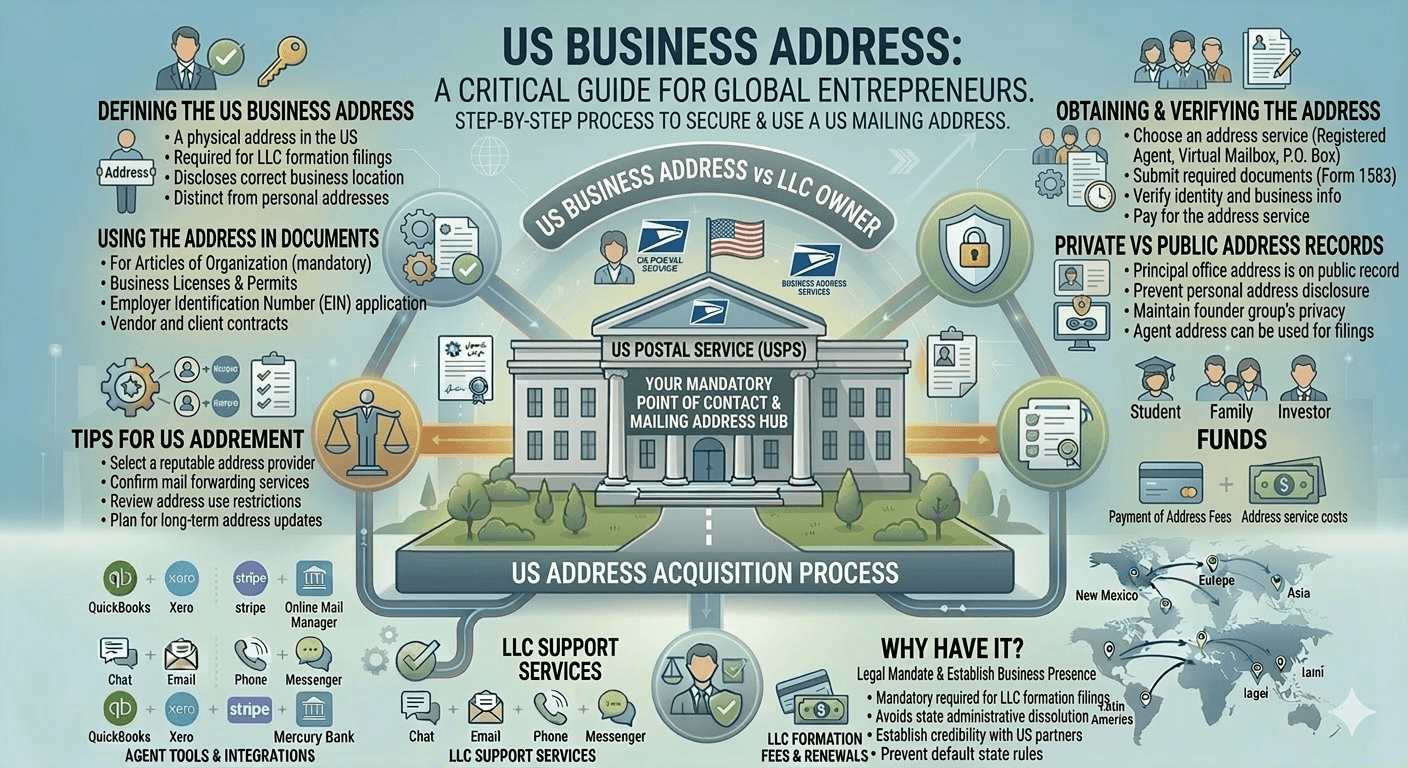
What is the structural distinction between a generic P.O. Box and a verified US Commercial Business Address for LLC compliance?
In the United States corporate legal framework, the distinction between a P.O. Box and a verified Commercial Business Address is profound. A P.O. Box is a strictly postal routing mechanism that lacks a verifiable physical street nexus. Consequently, the Secretary of State, the IRS, and high-tier banking institutions flatly reject P.O. Box parameters for LLC formation filings, registered agent addresses, and banking underwriting pipelines. A verified Commercial Business Address represents a physical storefront or a high-density office complex. For non-resident global founders, utilizing a professional commercial node is a mandatory compliance requirement. It provides a 'physical footprint' that satisfies the legal mandates for entity initialization, secures your credibility with banking institutions like Mercury, and functions as the mandatory landing strip for official court summonses (Service of Process).
How does the USPS Form 1583 protocol act as the gatekeeper for international business mail management?
The United States Postal Service (USPS) maintains strict protocols regarding the handling of commercial mail. Form 1583 serves as the official authorization manifest that allows a professional Registered Agent or commercial mail forwarder to receive and handle your entity's confidential government correspondence. As a non-resident founder, you must execute this form to legally authorize a third party to accept mail on your behalf. This involves notarizing your signature and providing verifiable passport copies to the mail-forwarding node. Without this authorization, your agent is legally restricted from opening, scanning, or forwarding your critical documents, creating a major operational bottleneck for founders managing their firm from international coordinates.
Why is a commercial business address the primary line of defense against personal identity exposure?
Transparency laws dictate that any address filed on your state Articles of Organization enters the public searchable domain. If you utilize a personal residential address, your global private coordinates become instantly indexed by search engines, competitive data miners, and aggressive public marketing networks. By deploying a professional commercial business address, you place a robust structural shield between your private life and your corporate activity. This node funnels all public inquiries, marketing spam, and official state correspondence to the professional agent's facility, allowing you to manage your corporate affairs from abroad while maintaining total residential privacy.
How do fintech neobanks and merchant processors validate business address integrity during underwriting sweeps?
Financial underwriting engines deployed by elite fintech platforms like Mercury and Stripe utilize sophisticated algorithmic address validation. These engines cross-reference your application's address against national USPS CASS (Coding Accuracy Support System) databases. If the address parameter you provide is flagged as a residential area, a blacklisted high-risk virtual mail drop, or a P.O. Box, the automated risk engine triggers an instant rejection or an indefinite account hold. Using a high-fidelity commercial business address node ensures that your underwriting profile passes these programmatic validation sweeps, maintaining account velocity and keeping your capital settlement routes open.
What are the specific operational requirements to maintain 'Good Standing' through address maintenance and annual reporting?
The structural location recorded on your state registry is not a static data point. You are legally obligated to update your principal office information whenever your operational nexus shifts. Failing to provide a current, active address leads to the degradation of your 'Good Standing' status. If the state attempts to mail official franchise tax notices or litigation alerts to an outdated, closed address, and these notifications are returned as 'undeliverable', the entity triggers automatic non-compliance flags. This results in severe administrative dissolution processes that can shutter your entire corporate structure within weeks.
ADDRESS INFRASTRUCTURE MATRIX
The Privacy Shield
- Permanently hide your residential location from public search indexes.
- Stop unwanted solicitor and public junk mail solicitation loops.
- Maintain a sovereign business front while operating from any international hub.
Banking & Trust Value
A verified commercial business address node confirms to neobanking and payment clearing algorithms that your firm is legitimate. This builds immediate institutional trust and allows you to bypass the restrictive underwriting flags common with virtual placeholders.
INTEGRATED LOGISTICS NODES
Senior Address Infrastructure Directives
- Ensure your mail-forwarding authorization (Form 1583) is notarized and processed immediately to initialize inbound document reception.
- Never route corporate entity legal documents to an unverified private mailbox, as state registrars require verifiable street coordinates.
- Archive all digitized correspondence logs from your forwarding portal inside your encrypted corporate storage ledger.
- Periodically audit your registered address status against banking records to ensure 100% data uniformity.
Regulatory Dissolution & Banking Lockout Matrix
Utilizing flagged, low-tier virtual drop-boxes or failing to maintain a verifiable commercial street nexus triggers automated regulatory flag loops. US banking algorithms cross-reference commercial address databases against postal data. If your address is identified as a fraudulent P.O. Box or a non-compliant residential zone, your merchant accounts are instantly suspended, clearing channels freeze your capital holdings, and the Secretary of State moves your entity toward administrative dissolution due to lack of a valid physical service-of-process conduit.
Physical Business Infrastructure Audit Complete
Protocol Node Check: US Commercial Street Presence Certified • Last Reviewed: May 19, 2026
S4HEL Online University Independent Research Node • Outbound Terminals Secured