Registered Agent
Compliance & Privacy Veil
An exhaustive legal-grade operational manual analyzing the statutory mandates of the Registered Agent, Service of Process dynamics, asset privacy shielding, and ongoing corporate standing maintenance.
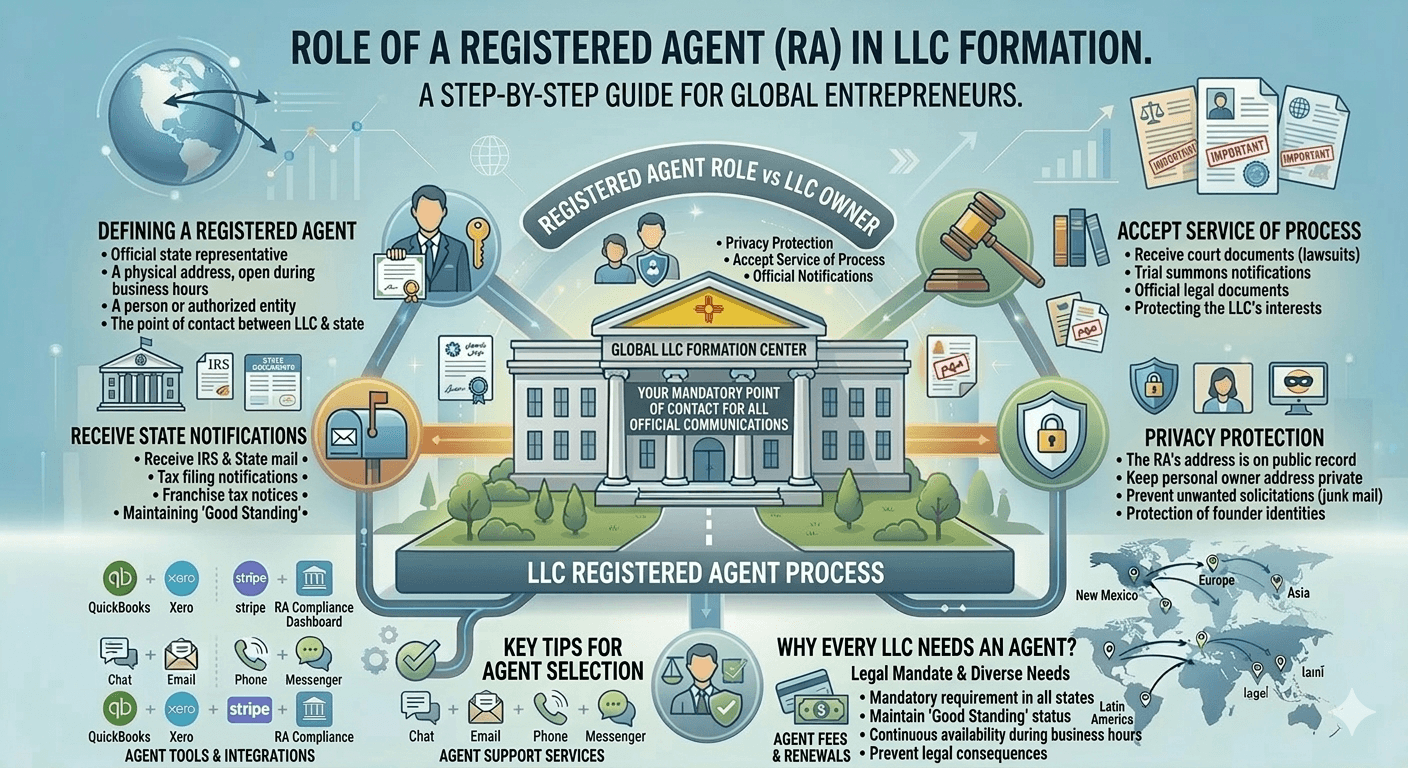
What is the statutory definition of a US Registered Agent, and why is it legally mandated across all 50 states?
A Registered Agent (frequently categorized as a Resident Agent or Statutory Agent depending on the specific territory) is an entity's officially designated point of presence within its state of formation. United States corporate laws dictate that every domestic or foreign limited liability asset must maintain a reliable physical conduit capable of receiving official communications directly from state governments. The Registered Agent must provide a verified physical street address—not an unverified P.O. Box or a digital mailing drop-off—and remain open during standard business hours (9:00 AM to 5:00 PM local time). This requirement exists to ensure the state can reliably deliver critical regulatory updates, tax notifications, and legal filings, establishing a baseline layer of corporate accountability across the marketplace.
What exactly is 'Service of Process', and what are the catastrophic legal defaults of a registered agent lapse?
The primary and most critical responsibility of a Registered Agent is the secure reception and processing of 'Service of Process' (SOP). This term encompasses legal summonses, formal complaints, lawsuit notifications, sub-poenas, and official court mandates leveled against your business entity. Under US civil procedure codes, delivering these documents to your Registered Agent constitutes legal notice to the entire firm. If your relationship with your agent lapses or they fail to process these documents quickly, the plaintiff can advance to a 'Default Judgment'. This means a court can award financial damages or restrict your business assets without your knowledge, resulting in immediate account freezes across connected neobanks and merchant payment networks.
How does a professional Registered Agent act as a corporate privacy shield for international non-resident owners?
The principle of transparency means that any data asset filed with a state business registry enters the public record, making it searchable by automated scripts, identity scrapers, and aggressive data miners worldwide. If you elect to act as your own agent or use an unverified residential location, your personal name and physical address are indexed publicly. Securing a professional Registered Agent network completely solves this vulnerability. The agent's certified commercial street address is used across all public fields on your Certificate of Organization and annual state filings. This constructs a secure corporate veil, keeping your sovereign physical location, residential data, and individual identity hidden from public directories while remaining fully compliant with state disclosure laws.
What specific tax notifications and compliance alerts pass through the Registered Agent node to preserve Good Standing?
Your Registered Agent functions as a strategic filtering nexus for critical state and federal document distributions. The agent receives your state's periodic filing prompts, annual franchise tax updates, and crucial informational notifications from the Internal Revenue Service (IRS). Professional agent networks integrate these documents into automated client portals, providing real-time data logs and system alerts ahead of critical deadlines. This support is essential for out-of-state operators to maintain 'Good Standing' status with the state registry, insulating the business from administrative delinquency flags, costly late penalties, and sudden system shut-downs across active checkout networks.
How do automated neobank systems and e-commerce platforms evaluate the status of your Registered Agent during underwriting sweeps?
Fintech business neobanks like Mercury and Relay Financial, alongside international payment clearings like Stripe, utilize programmatic risk models to constantly monitor the validity of your business entity. Their systems run background checks against state corporation division records. If your corporate profile shows a 'Registered Agent Resigned' flag or indicates your agent has lost their state license, the bank's automated compliance engine immediately marks your business node as high-risk. This triggers an immediate account freeze or onboarding hold, isolating your liquid capital and disabling payment routers until a certified agent is re-appointed and processed on the public registry.
MANDATORY AGENT REQUISITES
Core System Benefits
- Total public obfuscation filtering junk data and malicious solicitation loops away.
- Secure, reliable digital logging of official court summonses to prevent default verdicts.
- Constant availability during legal business hours inside your state jurisdiction.
Real-Time Regulatory Filtering
Your agent network operates as an active corporate filter, sorting official tax mandates, Secretary of State notices, and legal summonses. This ensure you handle structural documentation promptly, protecting your limited liability status from administrative drag.
COMPLIANCE LEDGER PLATFORM SYNC
Professional Agent Management Directives
- Verify that your choice of corporate representative carries an active, unexpired commercial agent license with the state registry database.
- Never implement personal individual addresses for state-level agent fields if you prioritize ownership data privacy shields.
- Review your digital client document inbox monthly to catch incoming federal and state reporting demands early.
- Remit agent maintenance fee renewals well ahead of expiration to prevent sudden registry compliance delinquencies.
Statutory Registered Agent Forfeiture & Dissolution Matrix
Allowing your statutory legal agent representation to expire triggers an immediate, automated entity failure routine. The Secretary of State will instantly shift your business status to 'Delinquent' or 'Suspended'. If a replacement agent is not registered within a strict grace frame, the state executes an Administrative Dissolution. This permanently voids your personal asset protection shield, terminates linked merchant transaction networks, shuts down banking lines, and exposes owners to direct individual liability loops.
Statutory Representation Node Audit Complete
Protocol Node Check: Registered Agent Topology Certified • Last Reviewed: May 19, 2026
S4HEL Online University Independent Research Node • Outbound Routing Locked