LLC Operating Agreement
Corporate Shield Blueprint
An exhaustive legal-grade operational textbook mapping out internal governance structures, limited liability insulation clauses, multi-member transition Buy-Sell rules, and automated financial underwriting passes cleanly.
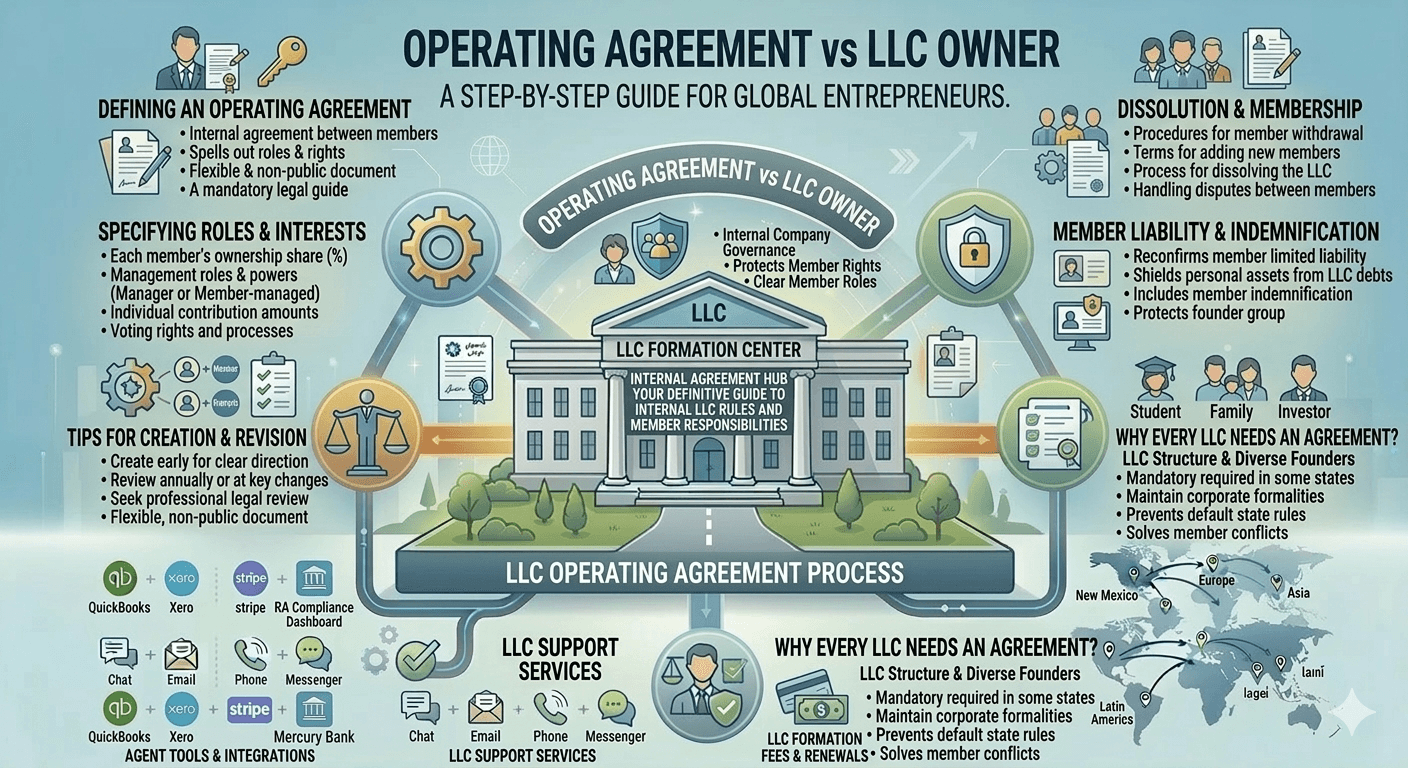
What is the true constitutional function of an LLC Operating Agreement, and why is it legally critical even if a state registry does not mandate its submission?
An LLC Operating Agreement functions as the internal sovereign constitution of a Limited Liability Company. It is a private, non-public contractual compact enacted by the entity's members to outline the complete operational, financial, and managerial parameters of the firm. A common systemic vulnerability for international non-resident founders is neglecting this document simply because specific state registries—like Wyoming or New Mexico—do not require it to be uploaded to the public state database during initialization. In United States mercantile courts, however, failing to produce a customized, fully executed Operating Agreement during a legal challenge is catastrophic. Without this document, your company is algorithmically classified as an incomplete structure or a mere personal alter-ego shell. This omission allows adversarial legal entities to easily pierce your limited liability protective veil, completely exposing your global individual assets to corporate collections and legal judgments.
How does an Operating Agreement insulate a borderless enterprise from arbitrary, default state statutory takeovers?
When a Limited Liability Company operates without a customized internal Operating Agreement, it automatically forfeits its corporate sovereignty to the default statutory rules of its state of formation. This means that if an internal management deadlock, equity transfer dispute, or capital allocation disagreement occurs, the state's rigid default legal codes will dictate the resolution. For international non-resident builders, these state default rules are poorly suited for cross-border e-commerce, software development, or speculative trading operations. For example, specific state default structures dictate that profits must be split strictly by the exact ratio of initial capital deposits, or they may require the immediate liquidation of the entire company if a single member drops out. Implementing a robust Operating Agreement allows founders to completely override these default state constraints, locking in custom capitalization pathways, rule-based profit sharing distributions, and sophisticated dispute resolution frameworks.
What are the structural distinctions between Member-Managed and Manager-Managed operational templates within a multi-member entity?
The Operating Agreement must explicitly define the systemic operational mechanics of the business by selecting either a Member-Managed or a Manager-Managed structural template. In a Member-Managed configuration, all equity owners retain direct, daily operational command of the entity. Every member possesses the legal authority to bind the firm to financial contracts, open commercial payment nodes, and sign joint joint ventures. This format is ideal for tight, highly collaborative founding squads. Conversely, a Manager-Managed framework completely isolates company ownership from daily executive command. In this setup, the members appoint specific individuals or specialized management entities (who do not need to hold any equity stakes) to run daily operations. This structure is non-negotiable for founders onboarding external passive investors, angel networks, or multi-jurisdictional partners, as it concentrates executive signature authority into chosen channels while protecting passive investors from unexpected liability.
What precise legal clauses must be drafted to govern multi-member equity dilution, member withdrawal, and administrative dissolution routes?
To ensure long-term corporate security, an Operating Agreement must contain character-perfect buy-sell and succession clauses to manage structural membership transitions without creating operational drag. The text must clearly detail: (A) Capital Call Protocols—the exact programmatic mechanism requiring members to provide extra funding rounds, and the corresponding equity dilution formulas if a member defaults. (B) Right of First Refusal (ROFR)—ensuring that if any member attempts to sell their corporate units to an unverified external entity, the surviving members retain the absolute primary right to purchase those shares to maintain internal custody. (C) Dissolution and Asset Liquidation Frameworks—mapping the chronological breakdown of company asset distribution, debt reconciliation, and permanent account closure parameters, preventing destructive internal litigation between global partners.
How do United States neobanks, global merchant channels, and automated underwriting scripts validate an Operating Agreement?
Modern fintech banking networks like Mercury and Relay Financial, alongside international payment processors like Stripe, utilize advanced systemic underwriting scripts to verify the legitimacy of non-resident applications. Because an Operating Agreement is a private document, it cannot be pulled from public state lookups. The bank's risk assessment engine requires you to upload the full, signed PDF manifest to run direct data matching checks. The compliance script extracts the text to cross-reference: (A) The exact legal name and state file number against the state charter. (B) The names and passport numbers of all individuals holding a 25% or greater beneficial stake to satisfy federal FinCEN criteria. (C) The explicitly stated executive manager titles to confirm who possesses legal authorization to sign corporate banking applications. Missing signatures or incomplete membership tables trigger immediate automated system rejections.
MANDATORY CORPORATE FUNCTIONS
Core System Operations
- Explicitly outlines internal ownership units, capitalization records, and percentage splits.
- Establishes robust corporate indemnification boundaries to protect the executive group.
- Completely prevents state default legislative takeovers from overriding your business choices.
Governance Model Flexibility
The structured agreement cleanly defines whether your corporate entity runs as a member-managed vehicle or shifts into a manager-managed track. This precision is absolutely vital to establish transaction authority indices required by venture fund networks, banks, and merchant platforms.
COMPLIANCE SYSTEMS LEDGER HOOKS
Senior Corporate Governance Directives
- Ensure all corporate founding members wet-sign or cryptographically timestamp the final agreement document immediately following state activation.
- Never implement copy-paste template agreements that contradict the specific statutory regulations of your chosen state of formation.
- Archive your agreement document inside secure, distributed cloud architectures alongside your processed state charter papers.
- Update and amend your internal membership tables within 30 days if any executive equity allocation transitions occur.
Corporate Veil Collapse & Default State Law Exposure Matrix
Operating an active cross-border business entity without executing a dedicated, tailored internal Operating Agreement triggers extreme corporate vulnerability. In the event of commercial disputes or civil litigation, US mercantile courts will immediately rule your company invalid, completely collapsing your corporate veil shield. This exposes all personal individual assets to aggressive worldwide collections, voids active merchant processing clearings, triggers automatic neobank treasury locks, and subjects your firm entirely to default state laws.
Internal Corporate Architecture Vetting Complete
Protocol Node Check: LLC Operating Governance Mapping Certified • Last Reviewed: May 19, 2026
S4HEL Online University Independent Research Node • Outbound Terminals Secured