Remote US Banking
Borderless Processing Loop
An exhaustive operational textbook mapping out biometric KYC frameworks, federal FATCA/IRS data synchronization loops, SWIFT wire transaction dynamics, and strict multi-account verification parameters for international founders.
What does the remote digital identity verification process entail for an international non-resident applying for a US business bank account?
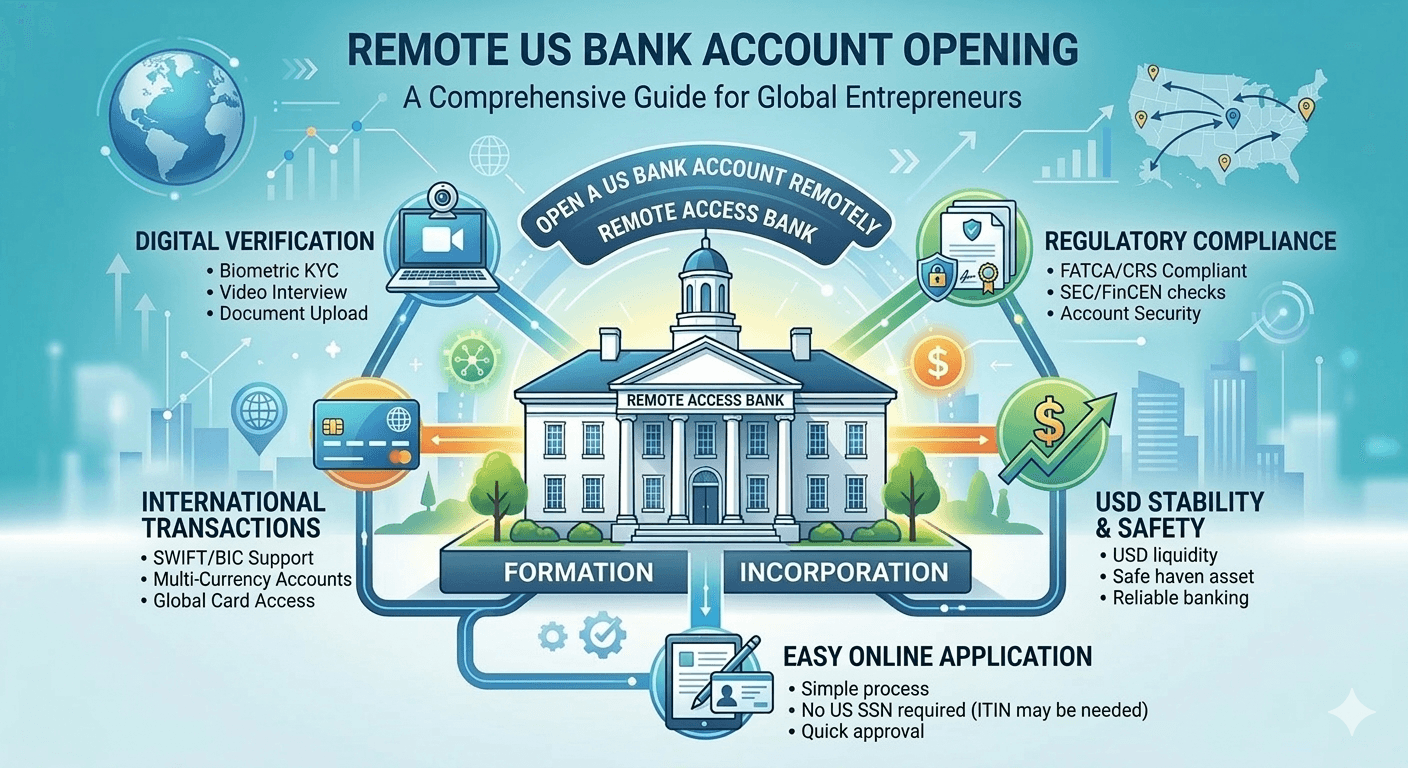
The initialization layer of remote business banking for cross-border founders relies entirely on high-fidelity biometric KYC (Know Your Customer) and digital verification frameworks. Because international applicants are not physically standing within a domestic US branch, clearing networks deploy advanced cryptographic identity scanning nodes. When you submit your application terminal parameters, you must upload high-resolution digital captures of your valid international passport and corporate formation records. This is immediately parsed by programmatic scanning engines that run multi-point algorithmic fraud checks. Furthermore, many high-tier clearings require an identity validation intercept, which includes a secure biometric liveness scan or a brief video verification interview. This technical pipeline guarantees to underwriting compliance desks that the human individual controlling the transaction parameters perfectly aligns with the beneficial ownership data indexed on state and federal registries.
How do international tax regulations like FATCA and CRS interface with remote US business checking nodes managed from abroad?
Operating a United States corporate bank account from an international coordinate introduces critical regulatory oversight frameworks managed by both federal bureaus and global tax data indexes. Non-resident corporate structures must completely align with the Foreign Account Tax Compliance Act (FATCA) and the Common Reporting Standard (CRS) data-sharing loops. While the United States does not fully exchange automated financial intelligence under CRS in the same manner as European nodes, federal financial systems require complete documentation to confirm your non-resident status. When your remote banking application is parsed, you must complete specific digital IRS declarations—typically Form W-8BEN for foreign individuals or Form W-8BEN-E for foreign corporate entities. This structural declaration formally establishes your zero-US-tax-nexus status, shielding your cross-border digital operations from arbitrary federal withholding sweeps while maintaining absolute regulatory alignment with FinCEN tracking parameters.
What specific technical clearings govern international SWIFT wire transaction velocity and multi-currency capital settlement routing?
Once your remote business checking node is fully approved and activated, your corporate capital moves through the absolute gold standard of global liquidity delivery. Your account provides native, direct integration into the domestic Fedwire network and the international SWIFT (Society for Worldwide Interbank Financial Telecommunication) clearing system, complete with dedicated BIC/SWIFT code metrics. For cross-border e-commerce builders, digital agencies, and speculative fund managers, this infrastructure layer enables frictionless multi-currency capital processing loops. Outbound global payments are executed with the identical transaction speed and institutional trust of a domestic US firm. However, you must carefully monitor intermediate routing pipelines: processing high-velocity wires to specific foreign jurisdictions requires clear, automated transactional invoicing data stored inside your bookkeeper systems to pass background regulatory screening loops without facing manual transaction holds.
Why is a verified US principal physical business address mandatory to satisfy automated neobank underwriting compliance sweeps?
This is the primary point of failure for unguided international founders attempting to establish US financial nodes. Automated risk underwriting engines deployed by platforms like Mercury, Relay Financial, or alternative US clearing banks run persistent validation sweeps against all applicant location parameters. Under strict federal anti-money laundering and Bank Secrecy Act rules, a financial institution is flatly forbidden from opening a corporate account backed exclusively by an unverified placeholder location or a generic shared virtual drop. Your principal address must represent a legitimate, verified physical commercial node recognized by federal postal indexing scripts. The bank’s compliance system cross-references your application fields against real-time address validation databases; if a generic P.O. Box or a highly flaggable shared mailbox loop is detected, the application faces immediate automated rejection or permanent lockout, isolating your entity from the clearing infrastructure.
What are the exact statutory requirements to clear banking risk filters without possessing a US Social Security Number?
Passing high-tier neobank risk assessment metrics as an out-of-state foreign national requires providing an alternative, ironclad structural documentation path. Since you lack a domestic Social Security Number (SSN), the underwriting engine shifts its structural assessment exclusively to your business identity and passport parameters. To completely satisfy the bank's clearing criteria, you must present a verified state-stamped Certificate of Organization, a completely signed internal Operating Agreement mapping out your entity's manager roles, and an official IRS EIN tax assignment letter (CP575 or 147C). While specific legacy institutions may demand a personal ITIN (Individual Taxpayer Identification Number) for manual credit checks, premier digital-first business neobanks focus their algorithmic risk models entirely on your corporate EIN data and verified international passport ledger, allowing you to access the stability of the US financial system without ever stepping foot on US soil.
USD ASSET PROTECTION PAYOFFS
USD Liquidity Stability
Securing a remote United States banking portal protects your business capital against local currency degradation, inflation drawdowns, and regional geopolitical volatility. Your cash reserves remain safely anchored inside the world's absolute primary safe-haven asset ecosystem.
Sovereign Global Connectivity
Manage your corporate capital allocations flawlessly from London, Istanbul, or any global hub. This advanced operational manual ensures your remote connection tokens remain secure, verified, and perfectly in sync with elite institutional wire standards.
CROSS-BORDER BANKING VERIFICATION INTERFACES
Senior Corporate Underwriting Directives
- Ensure your international passport carries at least 6 months of active validity prior to initializing biometric verification loops.
- Never route your banking terminal access through unverified public proxy networks; secure a clean, dedicated static server track.
- Obtain a certified, certified digital copy of your IRS EIN confirmation letter to instantly pass automated document scanners.
- Audit your principal commercial street address parameters quarterly to ensure permanent alignment with neobank risk parameters.
Transactional Suspensions & Account Seizure Risk Matrix
Attempting to disguise corporate transaction parameters or failing to comply with annual federal tax returns under your business entity triggers immediate, automated risk freezing. United States financial networks monitor transaction velocity and compliance alignments with extreme scrutiny. Any suspicious or unverified cross-border asset movement results in an immediate account block, freezing outbound wire processing systems and locking corporate capital indefinitely under federal compliance investigation protocols.
Borderless Financial Pipeline Audit Complete
Protocol Node Check: Remote USD Infrastructure Verified • Last Reviewed: May 19, 2026
S4HEL Online University Independent Research Node • Outbound Terminals Secured