Mercury vs Relay
US Banking Node Audit
An exhaustive comparison guide analyzing corporate fintech rails. Unpacking developer API boundaries, sweep network parameters, automated bookkeeper syncing metrics, and strict non-resident risk onboarding pipelines cleanly.
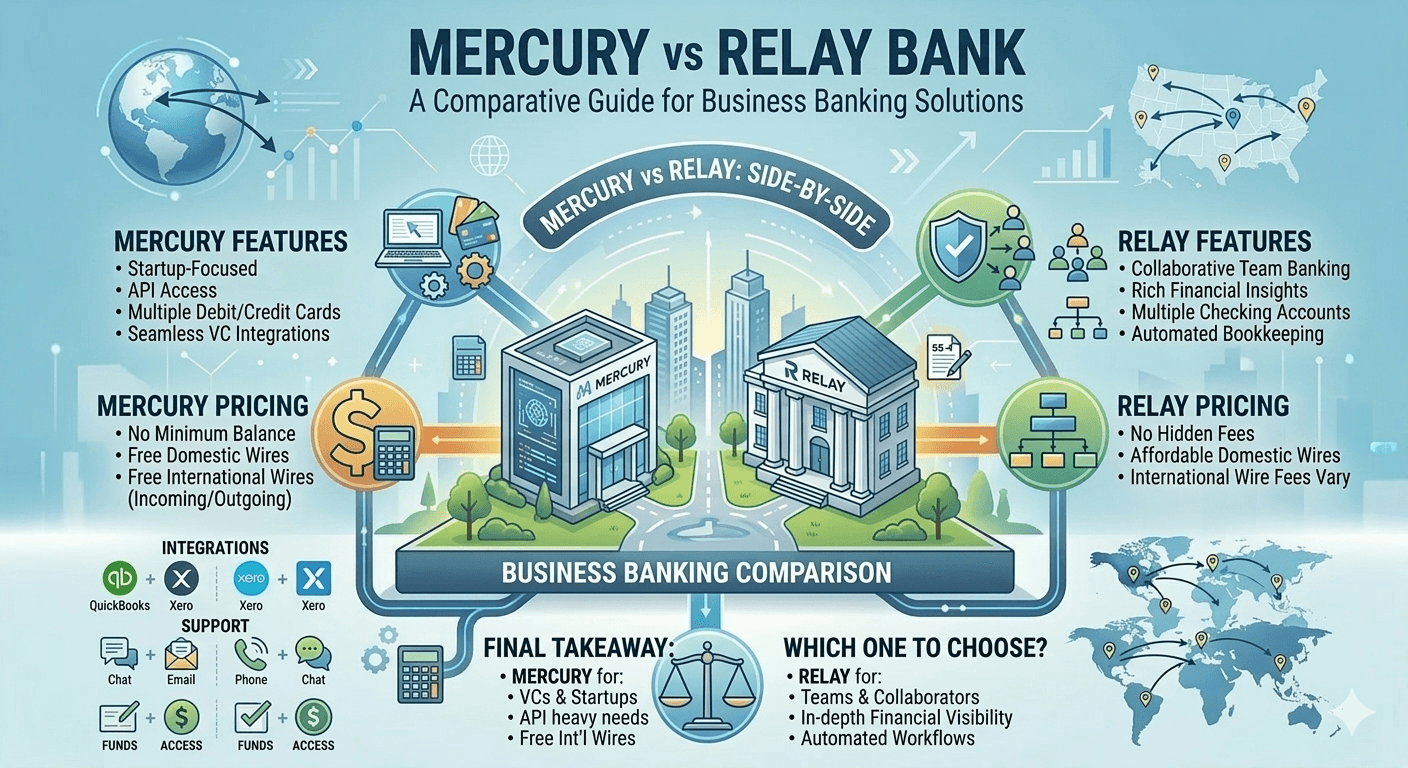
What is the core structural architecture of Mercury Bank, and why is it categorized as the premier standard for VC-backed startups?
Mercury is not a brick-and-mortar bank; it is a highly sophisticated financial technology platform operating in direct partnership with member clearing institutions like Choice Financial Group and Evolve Bank & Trust to deliver FDIC-insured repository slots. Mercury's internal core architecture is custom-engineered to meet the rapid capital deployment needs of technology startups, e-commerce giants, and venture-backed corporate assets. It features a developer-first interface highlighted by custom webhooks and robust API endpoints, allowing technical teams to completely automate corporate payout streams and sync treasury allocations programmatically. For global non-resident founders, Mercury provides a low-friction corporate onboarding track that completely eliminates traditional requirements for local domestic presence, granting immediate access to high-limit commercial virtual cards, automated venture capital tool integrations, and enterprise treasury management systems that yield optimized interest metrics on massive liquid reserves.
How does Relay Financial's architecture prioritize collaborative multi-account bookkeeping for agencies and growing management tiers?
Relay Financial provides an entirely different financial orchestration model designed explicitly for operational business structures, dense digital agencies, and distributed management teams. Relay’s structural hallmark is its unparalleled administrative permission layering and checking account decentralization parameters. The system enables corporate administrators to spawn up to 20 separate checking accounts, each uniquely mapped to individual department ledgers (e.g., Marketing, Payroll, Inventory Logistics, Software Upkeep) with distinct routing allocations. Furthermore, Relay delivers native multi-user access rules. This allows a non-resident founder to safely delegate precise viewing, editing, or transaction authorization controls to global accountants, remote virtual assistants, or internal division heads without risking account custody or exposing primary capital vaults. Relay's automated data feeds bridge character-for-character into accounting platforms like Xero and QuickBooks, turning manual data reconciliation into a historical anomaly.
What are the exact transactional pricing matrices, fee variations, and wire transfer constraints across both platforms?
For cross-border non-resident e-commerce operators, unexpected wire adjustments can compromise fragile product profit parameters. Let us benchmark the exact financial metric logs for both ecosystems: Mercury is internationally famous for enforcing a flat $0 fee structure on standard operations—demanding no minimum account balance thresholds, zero monthly maintenance fees, free domestic ACH transfers, and completely free incoming and outgoing international SWIFT wire transfers (with nominal currency conversion spreads applied on non-USD configurations). Relay Financial similarly operates with zero account minimum limits and features an entirely free basic framework. However, Relay offers a premium configuration track called 'Relay Pro' ($30/month) to unlock continuous rule-based wire automation, mass batch payment clearings, and completely free outbound domestic wires, whereas standard international SWIFT costs on Relay can scale on a per-transaction basis. Your choice must be driven by your expected cross-border transaction frequency.
How do automated automated cash management algorithms and FDIC data insurance parameters function in modern neobanking setups?
Sovereign capital protection is the primary criteria for enterprise operational integrity. Since both platforms manage client holdings via partner banking institutions, they utilize sophisticated 'Sweep Networks' to maximize your legal asset insulation. Standard FDIC protection matrices insure single-account holdings up to a flat $250,000 threshold. Mercury’s programmatic vault systems systematically sweep capital above this limit across a network of up to 20 separate institutional clearing banks, legally compounding your structural insurance threshold up to an epic $5,000,000 without requiring manual account updates. Relay Financial utilizes similar systemic distribution partnerships to scale FDIC protection flags up to a secure $3,000,000 buffer. This automated treasury balancing completely shields your corporate liquidity allocations from localized institutional failure vectors, keeping your borderless corporate capital completely bulletproof.
What specific corporate document sets and verification loops must a non-resident provide to pass onboarding risk screening checkpoints?
Both Mercury and Relay employ programmatic AI-driven compliance models to run real-time AML (Anti-Money Laundering) and KYC (Know Your Customer) screening passes. To bypass their strict onboarding verification blocks, an international non-resident structure must provide character-perfect corporate files. The mandatory documentation index requires: (A) A certified, active state formation record (Articles of Organization or Certificate of Incorporation). (B) An official, fully processed IRS EIN tax assignment letter (CP575 or 147C). (C) A valid, high-resolution international passport tracking page for all human owners holding 25% or greater equity control. (D) A verified physical principal address—the system cross-references public databases and will instantly auto-reject virtual placeholders, low-tier mail drops, or flagged P.O. Boxes to prevent transaction routing fraud.
TARGET STRUCTURAL SEGMENTATION
Mercury System Triggers
- High-tier technology startups, programmatic SaaS setups, and VC-backed operations.
- Developers requiring advanced internal backend custom webhook tracking.
- Formations routing large global wire balances across international SWIFT zones.
Relay System Triggers
- Dynamic digital agencies, collaborative companies, and multi-partner networks.
- Founders demanding complex sub-account tracking parameters over distinct budgets.
- Automated bookkeeping integrations that cleanly feed transactional metadata directly into Xero.
SYSTEMIC FINANCIAL DATA SYNC HOOKS
Senior Banking Allocation Directives
- Audit your corporate address validation status explicitly before loading checking applications to guarantee automated system passes.
- If your entity runs high-volume multi-currency international commerce, optimize Mercury's programmatic treasury tools to protect capital.
- For dense team operational scaling, configure Relay's distinct sub-account parameters to enforce hard limits on secondary virtual credit links.
- Ensure all corporate resolution documentation is signed and timestamped under your official Operating Agreement framework prior to file upload.
Neobank Operational Freezing & Risk Mitigation Matrix
Deploying generic virtual mail drops or failing to update corporate structural modifications with the IRS will cause immediate programmatic banking locks. Modern digital banking engines execute constant background audits on state registries. Any detected default status, registered agent lapse, or unverified ownership shift triggers immediate automated restriction flags, freezing outbound transaction processing routes and isolating active liquidity lines indefinitely until formal regulatory re-audits are cleared.
Borderless Financial Infrastructure Audit Complete
Protocol Node Check: US Business Banking Topology Verified • Last Reviewed: May 19, 2026
S4HEL Online University Independent Research Node • Outbound Routing Terminals Locked