LLC vs Corporation
Sovereign Gateway Audit
The definitive comparative encyclopedia for cross-border innovators. A rigorous diagnostic analysis mapping pass-through fiscal structures against venture-capital stock configurations, mandatory governance stacks, and automated underwriting loops.
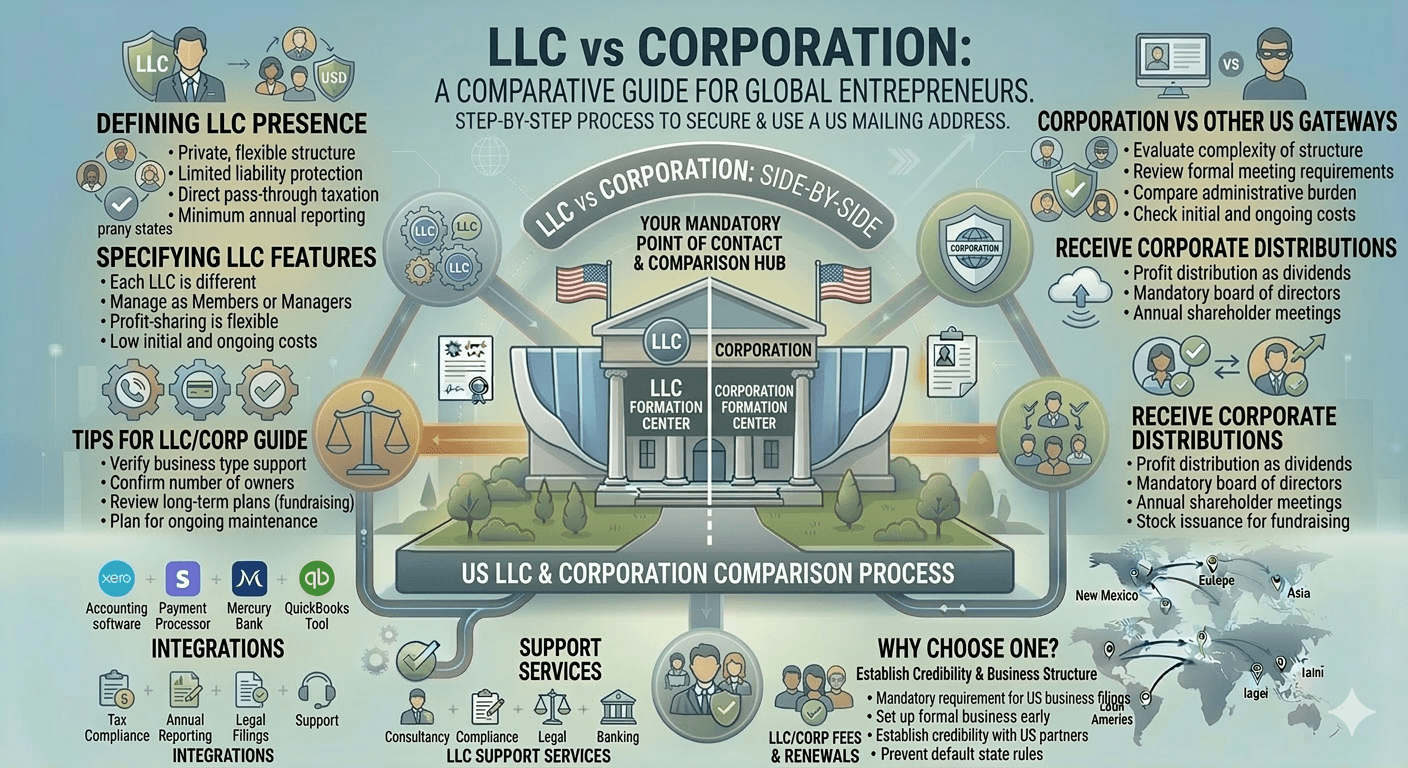
What are the core structural definitions of a US LLC versus a Corporation, and how does the pass-through tax matrix operate?
A United States Limited Liability Company (LLC) and a Corporation represent two completely separate species of legal architecture. An LLC is a flexible, modern hybrid entity engineered to combine the absolute asset protection veil of a corporation with the fiscal agility and simplicity of a partnership. The defining operational benefit of an LLC for an international non-resident builder is 'Pass-Through Taxation'. Under IRS regulations, corporate profits pass directly to the owners (members) without being taxed at the organizational level, completely eliminating double taxation loops. Conversely, a Corporation (specifically structured as a C-Corp) stands as an entirely rigid, separate tax entity. A C-Corp is subject to federal corporate income taxes (flat 21%) on its net earnings, and when dividends are subsequently distributed to global shareholders, those distributions face secondary personal tax assessments. For cross-border ventures without a physical US footprint, the LLC delivers an unrivaled tax-neutral environment, whereas the Corporation acts as the mandatory gateway for massive capital accumulation pipelines.
How do internal management structures, administrative oversight, and maintenance overhead costs diverge between these entities?
The administrative velocity of your enterprise is governed by your corporate structural format. LLCs operate under absolute internal flexibility: they can be Member-Managed (run directly by the investors) or Manager-Managed (delegated to appointed executives). Profit sharing allocation metrics can be dynamically tailored within your Operating Agreement without being bound to rigid equity ownership percentages, and ongoing administrative burdens are minimal. A Corporation removes this flexibility entirely. It enforces a mandatory multi-tiered governance stack: Shareholders elect a Board of Directors, who oversee macro corporate policy and appoint Executive Officers (CEO, CFO, Secretary) to handle daily operations. Corporations are legally bound to hold formal annual shareholder assemblies, maintain meticulous corporate meeting minutes, and document all strategic executive moves via formal resolutions. Failing to maintain this paper trail allows external entities to pierce the corporate veil easily.
What are the exact compliance mechanisms governing corporate profit distributions, stock issuances, and venture capital readiness?
If your multi-year operational roadmap demands onboarding external venture capital networks, executing public equity offerings, or providing stock incentives to distributed developer teams, a Delaware C-Corporation is the absolute global benchmark. Venture capital funds are structurally restricted from investing in pass-through LLCs due to complex tax routing blockers. A Corporation allows for the precise, infinite division of ownership through the issuance of authorized shares of stock. It accommodates sophisticated capitalization tables, multi-tier stock classifications (such as Preferred Stock with liquid preference multipliers versus Common Stock), and seamless equity allocation routes. LLCs do not issue stock; their internal structures are divided via abstract 'Membership Interests' or percentage units, which require complex manual rewrites of the Operating Agreement whenever new capital is introduced, making them poorly suited for high-velocity fundraising tracking loops.
What ongoing state upkeep parameters and long-term regulatory reporting burdens apply to each business framework?
Long-term corporate maintenance costs scale dynamically based on the regulatory burden of your business type. An LLC generally enjoys a low-overhead maintenance profile: states like New Mexico require zero ongoing state report fees, Wyoming requires a nominal $60 yearly state treasury declaration, and Delaware mandates a flat $300 alternative tax. A Corporation faces much more intensive recurring systemic scrutiny. Delaware corporations, for instance, must file an annual franchise report before March 1st with fees calculated via complex Authorized Shares or Assumed Par Value Capital methods that can quickly scale into thousands of dollars if equity indices are configured poorly. Furthermore, both entity variations must independently satisfy mandatory federal FinCEN Beneficial Ownership Information (BOI) data clearings under the Corporate Transparency Act to preserve active operational validation parameters.
How do international neobanking networks and merchant clearing platforms vet an LLC versus a Corporation?
Fintech treasury clearing platforms like Mercury, Relay Financial, and global checkout gateways like Stripe utilize automated systemic algorithms to evaluate risk vectors across incoming entity applications. When vetting an LLC, their compliance engines parse your Certificate of Organization and single or multi-member Operating Agreements to map ownership tracks. When processing a Corporation, the underwriting filters demand your formal state-stamped Articles of Incorporation, fully ratified Corporate Bylaws, and specific Board Resolutions authorizing account openings. Mismatching files or incomplete governance records within a corporate stack trigger immediate automated KYC onboarding failures. Corporations face slightly more stringent banking vetting due to historical regulatory constraints surrounding international equity movements, requiring character-perfect filing data across all corporate fields.
SYSTEMIC FRAMEWORK MATRIX
The LLC Operational Pathway
- Direct shield insulation protecting personal international capital assets from tracking.
- Complete 0% pass-through tax efficiency loops on verified foreign source net revenues.
- Minimum annual report upkeep overhead and fluid structural multi-member parameters.
The Corporation Capital Pathway
- Infinite scalability via standard authorized stock certificate distribution passes.
- High systemic trust matrices matching direct requirements of global angel networks.
- Mandatory board of directors implementation creating concrete corporate custody boundaries.
Enterprise Compliance Integration
S4HEL functions as a sovereign educational clearing nexus. We provide absolute data synchronization architectures for both operational LLC tracks and complex institutional corporate frameworks globally.
Financial Rail Telemetry
Both entity profiles deliver character-perfect compatibility hooks targeting modern financial systems, including IRS withholding filings, high-tier business neobanks, and automated Stripe clearings.
Senior Architecture Selection Directives
- If your multi-year strategy maps tokenization models or public fundraising rounds, initialize as a Delaware C-Corp immediately.
- For e-commerce, dropshipping, and standard independent digital retrial setups, prioritize a Wyoming LLC to minimize ongoing overhead tax friction.
- Never mix your company operational accounting vectors; maintain concrete corporate separation to preserve your limited liability shields.
- Verify that your final structural bylaws or operating agreement metrics match your FinCEN BOI transparency logs character-for-character.
Statutory Entity Breakdown Warning Matrix
Deploying an incorrect entity infrastructure profile without mapping your specific tax nexus constraints results in systemic corporate failure. Corporations that fail to execute annual franchise assemblies or LLCs that neglect statutory state reporting windows face absolute corporate veil pierces. This removes your operational protection armor, triggers permanent system account blocks across payment routers, freezes liquid cash cash lines within banking pipelines, and exposes founders to direct personal asset enforcement loops worldwide.
Corporate Structure Integrity Audit Complete
Protocol Node Check: LLC vs Corp Structural Topology Certified • Last Reviewed: May 19, 2026
S4HEL Online University Independent Research Node • Outbound Routing Locked