How to Launch a US LLC
Borderless Master Guide
The definitive blueprint for cross-border builders. An exhaustive, step-by-step operational diagnostic mapping state selection algorithms, IRS parameters, asset insulation agreement drafting, and financial rail validation loops cleanly.
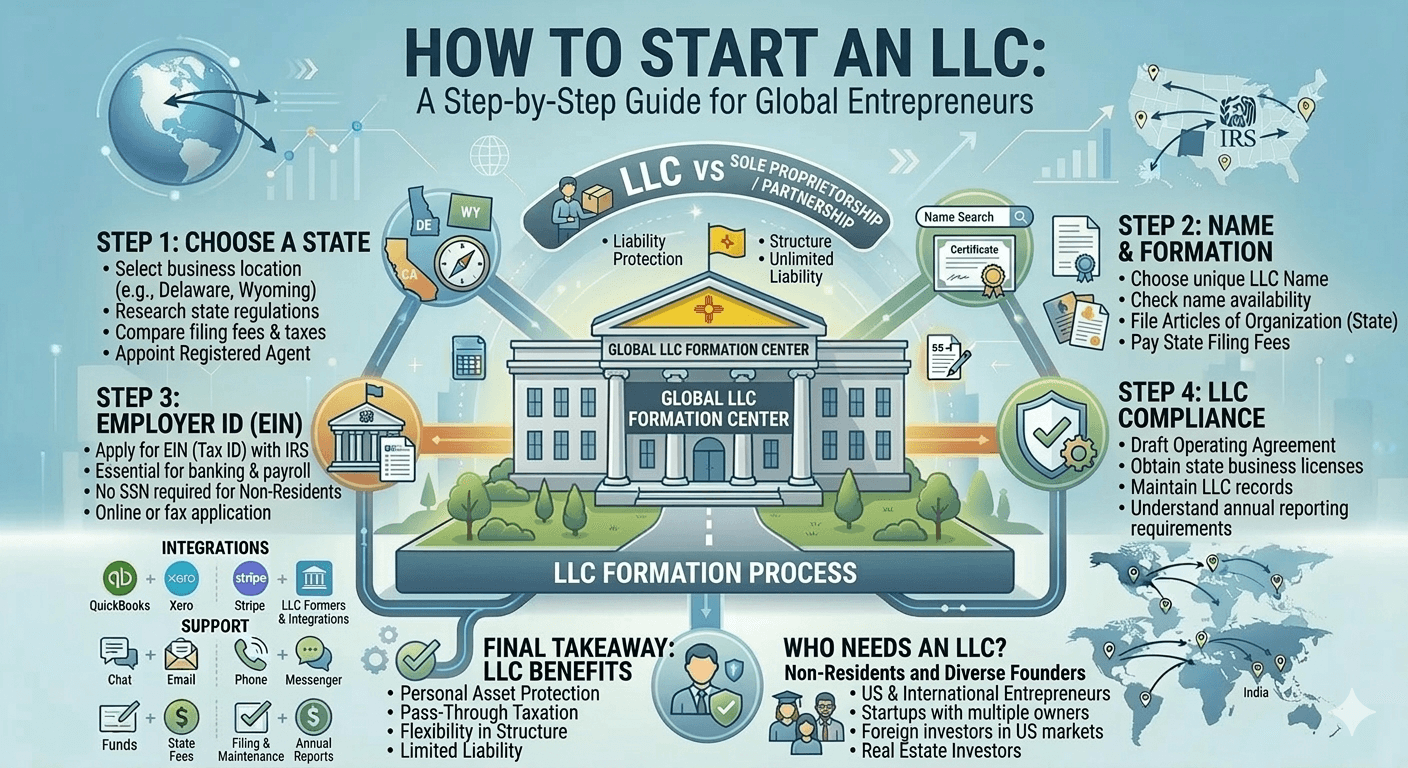
How does an international non-resident entrepreneur select the optimal state jurisdiction for corporate formation?
The primary structural decision an international builder faces when navigating the United States corporate landscape is jurisdiction mapping. In the US, companies are not registered at a centralized federal level; instead, they are formed within individual state corporate registries, each functioning under distinct statutory codes. For global non-resident entities, the choice typically narrows to Wyoming or Delaware. Wyoming represents the absolute benchmark for solo founders, small-to-medium enterprises, and high-velocity e-commerce operations. It features very low initial entry overhead ($100 state fee), a minimal annual maintenance index ($60), and robust asset anonymity protections that keep member configurations entirely off public directories. Delaware, conversely, is engineered as the mandatory environment for startups seeking institutional venture capital or aiming for an IPO. Delaware General Corporation Law combined with the specialized Court of Chancery provides the high-tier protection templates preferred by investors globally. Regardless of your choice, you must appoint a licensed Registered Agent physically located within that specific state to maintain your entity's active legal standing and receive incoming official state telemetry.
What are the exact statutory parameters for executing an LLC name availability clearance and processing Articles of Organization?
Your corporate name must maintain absolute uniqueness and distinct classification inside your chosen state's database index. It must include an explicit organizational designator such as 'Limited Liability Company', 'LLC', or 'L.L.C.'. Once name availability is cleared through real-time state database queries, you must compile and transmit the formal Articles of Organization (alternatively tracked as a Certificate of Organization depending on the territory). This document acts as the official birth certificate of your business node. For non-resident founders, processing this documentation electronically via state portals requires inputting the physical parameters of your certified Registered Agent, defining whether the entity operates as Member-Managed or Manager-Managed, and remitting the legal state registry fees. Any character mismatch or use of unverified placeholder addresses will cause immediate system processing rejection by state registrars.
What is the precise procedural mechanism to secure a Federal Employer Identification Number (EIN) as a non-resident with zero US SSN or ITIN credentials?
An Employer Identification Number (EIN) acts as the permanent corporate tax identity issued directly by the Internal Revenue Service (IRS). For international non-residents with zero domestic credit or Social Security parameters, the automated online IRS application node is inaccessible. To bridge this regulatory barrier, you must execute an analog filing via Form SS-4. This methodology requires entering character-perfect corporate details matching your state filing, nominating an international individual passport holder as the 'Responsible Party', and transmitting the package directly to the specialized IRS foreign operations branch via dedicated fax networks or managed international mail. This analog processing track requires manual verification by live federal agents and typically commands a 15 to 30 business day clearance window, resulting in the issuance of an official CP575 or 147C tax identification letter required to unlock commercial merchant channels.
Why is an internal Operating Agreement legally mandatory to fortify corporate shields, and what are the perpetual compliance baselines?
Many international founders erroneously believe that once the state processes their Articles of Organization, their legal asset protection is absolute. In United States mercantile courts, your corporate liability shield must be constantly maintained. If you do not draft a comprehensive internal Operating Agreement, your entity is highly vulnerable to being classified as a mere pass-through alteration or an unseparated personal shell. The Operating Agreement establishes your internal equity capitalization tracks, defines voting control distribution metrics, maps out operational succession plans, and explicitly details the separation between personal resources and company assets. This document is not submitted to the state registry but must remain archived within your corporate storage systems alongside continuous compliance protocols—such as annual state reporting and federal transparency statements—to prove your company operates with clean, bulletproof legal precision.
How do US banking rails and global payment merchant infrastructure layers validate a non-resident LLC configuration?
Once your state and federal layers are fully synchronized, your business node can integrate with high-tier fintech banking rails like Mercury or Relay Financial, alongside top-tier processing matrices like Stripe. These financial platforms run programmatic KYC and AML compliance passes on your structure. Their validation engines require: (A) A certified, active state formation document. (B) An official IRS EIN assignment letter (CP575 or 147C). (C) A valid international passport tracking log for all beneficial owners holding a 25% or greater equity stake. (D) A verified, premium US-based physical business address. Attempting to use flagged, shared virtual mailboxes or low-grade placeholder locations will cause an immediate system freeze, isolating your global processing routes until structural re-audits occur.
STRUCTURAL ENTITY HIGHLIGHTS
Pass-Through Fiscal Agility
A non-resident single-member LLC benefits from complete federal tax pass-through status. If no physical infrastructure or employment layer exists within the United States borders, your global digital retail and software profits maintain a 0% corporate tax rating.
Sovereign Borderless Reach
The United States structure acts as a universally accepted validation key. By deploying a verified state entity, foreign founders instantly acquire the operational leverage, high-tier gateway configurations, and payment settlement trust indices matching top US firms.
Fintech Gateway Validated
Mercury, Relay, and Stripe system architecture ready.
Privacy Sheaths Deployed
Utilize premium corporate addresses to completely obfuscate ownership logs.
Upkeep Chronometers
Automated ledger warnings mapped to preserve constant Good Standing status.
Senior Formation Execution Parameters
- Perform an exhaustive conflict lookup in your target state corporate directory index before drafting Articles of Organization.
- Never use cheap, unverified shared public drops for your principal address fields; utilize high-fidelity digital infrastructure layers to pass bank screenings.
- Formulate a complete Operating Agreement immediately after receiving your processed state vouchers to fortify your corporate shield.
- Fulfill your FinCEN Federal Beneficial Ownership Information statement within 90 days of formation to isolate your firm from statutory federal penalties.
Corporate Veil Piercing & Dissolution Matrix
Failing to maintain a strict legal separation between individual personal assets and corporate infrastructure tracks leads directly to a legal condition known as 'Veil Piercing'. In mercantile litigation, this entirely strips away your limited liability protection layer, exposing your personal personal capital to global collectors. Additionally, neglecting state periodic report horizons parameters causes automated entity dissolution, freezing linked processing nodes and terminating business banking clearings immediately.
Corporate Formation Infrastructure Audit Complete
Protocol Node Check: US LLC Initialization Architecture Certified • Last Reviewed: May 19, 2026
S4HEL Online University Independent Research Node • Outbound Terminals Secured