EIN Tax ID
Federal Master Guide
An extensive regulatory-grade diagnostic manual mapping the exact operational frameworks required for international non-residents to secure, format, and maintain verified IRS Employer Identification Numbers without domestic tax liability.
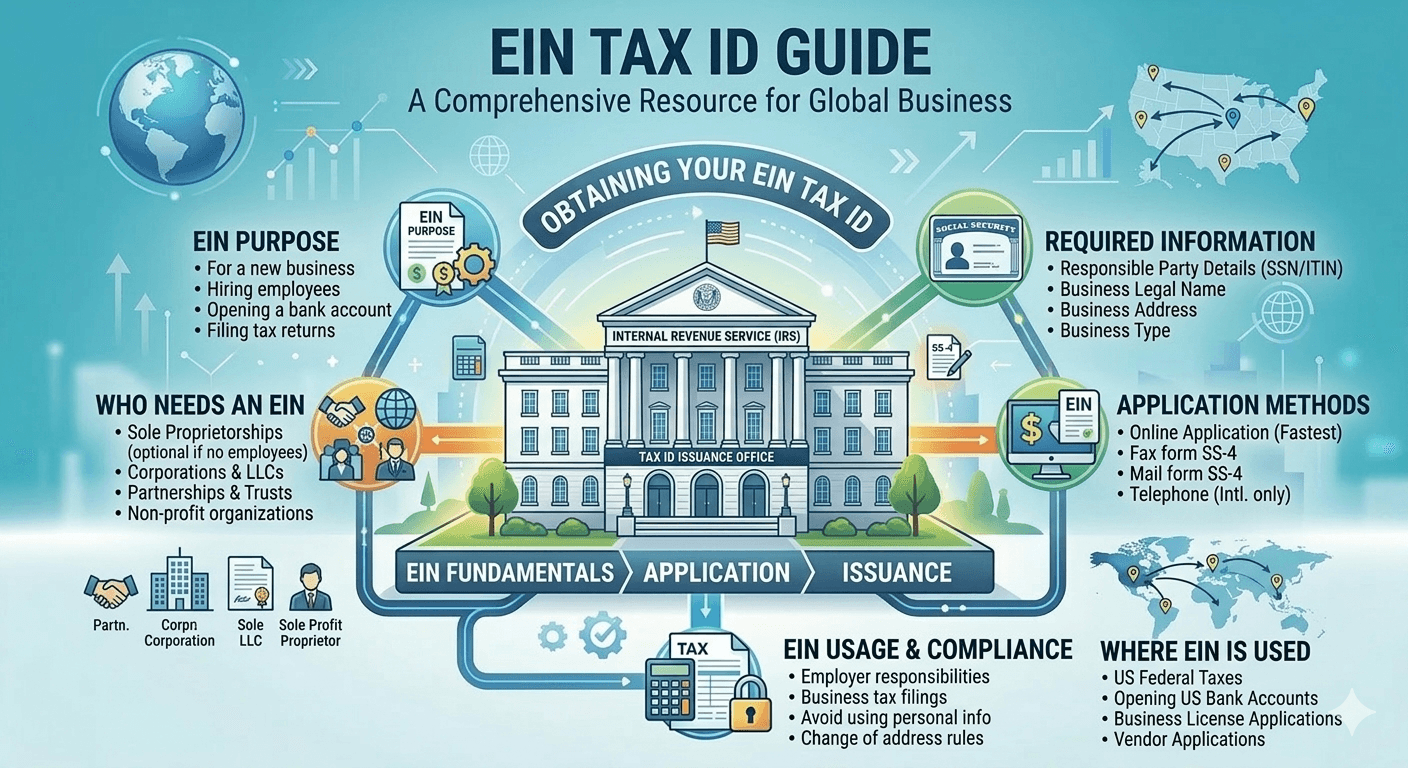
What is an Employer Identification Number (EIN), and why is it structurally classified as the core foundation of US business identity?
An Employer Identification Number (EIN), legally tracked as a Federal Tax Identification Number, is a unique nine-digit numeric cipher issued directly by the Internal Revenue Service (IRS). Think of it as the biometric Social Security Number (SSN) but uniquely engineered for corporate assets. Without an active EIN, a Limited Liability Company or Corporation remains an isolated state shell node, completely locked out of the United States economic infrastructure. It is the core mechanism used to track enterprise transaction velocity, satisfy withholding tax criteria, manage team member payroll metrics, and file annual fiscal statements. For non-resident global founders, the EIN is the primary ledger parameter demanded by top-tier financial technology payment rails like Stripe, alongside global banking clearings like Mercury or Relay Financial, to authorize merchant capital settlements.
How can international non-resident founders legally secure a corporate EIN without a US SSN or ITIN?
A common misconception among international builders is that obtaining a US Tax ID requires a domestic Social Security Number (SSN) or an Individual Taxpayer Identification Number (ITIN). The IRS maintains a dedicated compliance loop specifically designed for foreign non-resident managers. If you do not possess domestic personal tax numbers, the online IRS application portal will auto-reject your session. Instead, you must utilize the manual Form SS-4 configuration vector. This requires compiling a comprehensive physical document package where your foreign identity metrics are mapped cleanly, your corporate legal designation is specified exactly as initialized in your state formation records, and a non-US citizen is declared as the 'Responsible Party'. This package must be routed via secure analog channels—specifically specialized IRS fax terminals or dedicated international mailing hubs located in Cincinnati, Ohio—to manually bypass automated domestic filters.
What are the exact technical processing loops and timing horizons for foreign Form SS-4 applications?
When filing an analog Form SS-4 as an international builder, timing horizons scale dynamically based on the seasonal transaction volume hitting IRS intake hubs. While a domestic founder utilizing an SSN can generate an EIN instantly online, the non-resident fax track typically demands between 15 to 30 active business processing days. Once received by the specialized IRS foreign operations division, a live agent manually reviews the alignment of your Certificate of Organization against your Form SS-4 syntax. Any abbreviation error, character mismatch, or unverified structural address parameter triggers an immediate processing rejection. Once verified, the IRS assigns the nine-digit identity and dispatches an official CP575 or 147C validation document via standard post or return fax, which stands as your permanent institutional validation key.
Why does mismatching data fields on Form SS-4 cause immediate merchant gateway and neobank account freezes?
Modern financial ecosystems operate on automated cryptographic KYC (Know Your Customer) and AML (Anti-Money Laundering) matching algorithms. When you apply for an enterprise merchant account with Stripe or launch a digital treasury node with Mercury Bank, their verification engine routes a real-time data look-up query directly to the internal IRS database index. If your name formatting, punctuation characters, or corporate spacing parameters inside your payment dashboard deviate even slightly from your official IRS CP575 tracking notice, the system triggers an immediate data mismatch flag. This results in an instant onboarding rejection or a complete account freeze, locking your checkout pipelines and isolating active company reserves until manual documentation audits are completed by human legal specialists.
How does an EIN interface with non-resident single-member LLC US tax optimization boundaries?
An EIN is essential to maintain the structural pass-through tax agility guaranteed to non-resident single-member LLC networks. If an international founder initializes a US company, has zero physical workforce nexus on US soil, and utilizes no localized distribution centers, the entity is classified under IRS parameters as 'Foreign Source' and 'Disregarded Entity' for federal income tax evaluation. This means your global e-commerce, software development, or speculative trading profits are subject to a 0% US federal tax index. However, this tax-neutral environment is strictly dependent on completing annual informational disclosures. You must utilize your legal EIN to file Form 5472 and Form 1120 with the IRS every single fiscal cycle. Failing to execute these informational manifests under your assigned EIN triggers an absolute statutory minimum penalty of $25,000 per missing year, regardless of your global net income.
IRS METRIC DISPATCH TARGETS
Primary Operational Channels
Your assigned corporate EIN will act as your permanent institutional identifier across premium merchant processors (Stripe), enterprise neobanking channels (Mercury, Relay), international commercial customs routing manifests, and formal annual state transactional licensing.
Sovereign Borderless Alignment
Non-resident structural networks face absolute exclusion without a properly indexed tax number. The application tracking loop must be managed by certified corporate operators who understand how to structure Form SS-4 parameters to bridge compliance screening checks cleanly.
IRS Operational Directives & Compliance Tips
- Always match the corporate spelling on your Form SS-4 precisely with the processed Certificate of Organization from your state of initialization.
- Never use generic unverified shared mailbox coordinates on your IRS templates, as federal tracking systems automatically flag and reject non-physical locations.
- Archive your official IRS CP575 or 147C tracking document inside an encrypted, offline offline storage vault; it is required for all bank account setups.
- If your principal office relocates globally, update the IRS database parameters immediately via Form 8822-B within 60 days to protect your standing.
Statutory IRS Failure to File Penalty Warning
Failing to maintain accurate data or neglecting to file annual information returns (Form 5472 / 1120) under your corporate EIN triggers immediate federal statutory penalties starting flatly at $25,000 per violation loop. The Internal Revenue Service enforces severe asset extraction mechanics on unmitigated corporate defaults, which immediately halts connected neo-banking clearances, locks local merchant settlement gateways, and compromises the legal protection of your borderless enterprise.
Federal Intellectual Infrastructure Audit Complete
Protocol Node Check: IRS Tax ID Mapping Certified • Last Reviewed: May 19, 2026
S4HEL Online University Independent Research Node • Outbound Routing Terminals Locked