The Ultimate Non-Resident
Annual Report & Upkeep Guide
An exhaustive, regulatory-grade operational diagnostic manual blueprints. Engineered specifically for international founders managing United States structures to bypass administrative dissolution, navigate state tax tracking loops, and fulfill FinCEN federal disclosures perfectly.
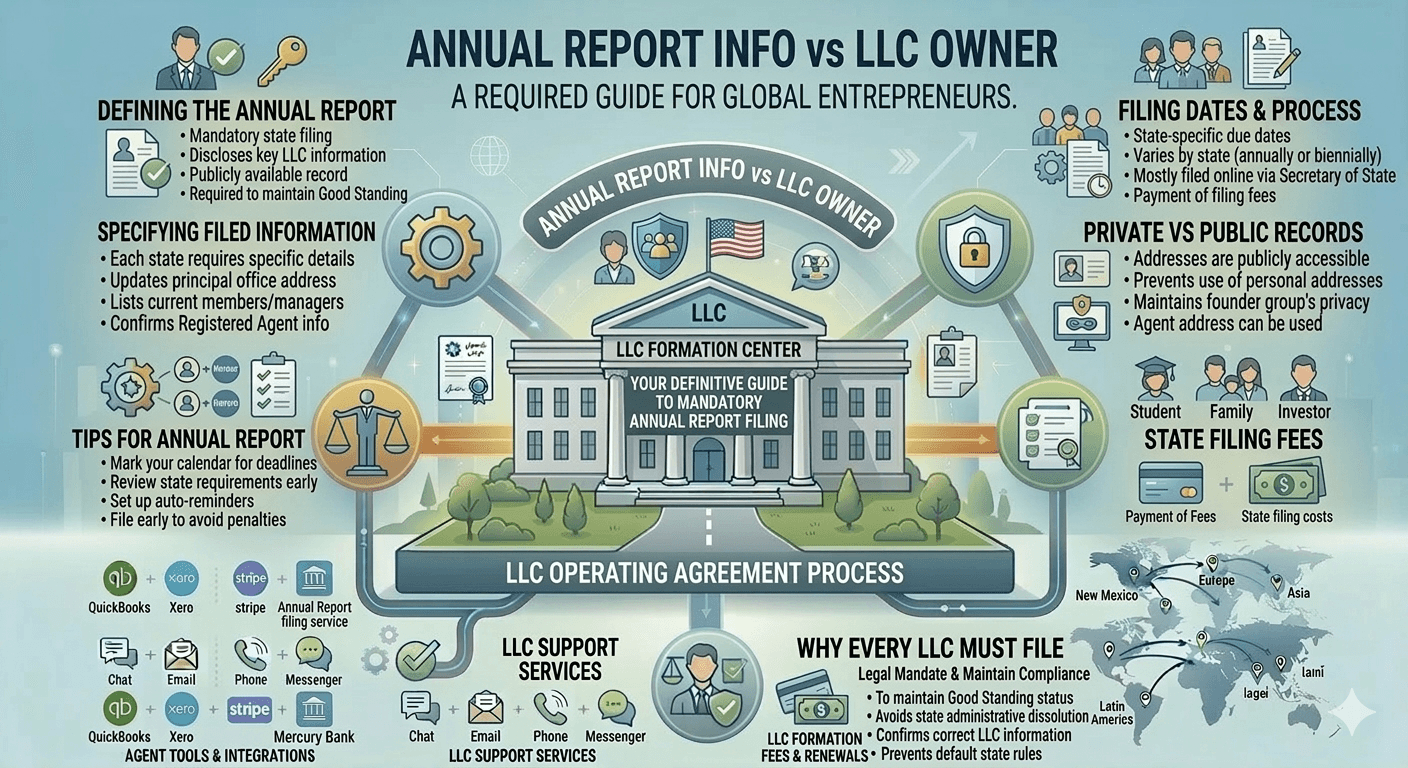
What is the actual legal purpose of a United States Annual Report, and why is it mandatory for out-of-state non-resident entrepreneurs?
When a global non-resident founder registers a localized business entity—such as a Limited Liability Company (LLC) or an enterprise Corporation—in states like Wyoming, Delaware, New Mexico, or Texas, that entity enters into a binding operational nexus with the respective Secretary of State. The Annual Report (frequently categorized as a Periodic Report or Statement of Information depending on the unique territorial taxonomy) acts as the baseline legal validation bridge designed to maintain a synchronized record of active entities operating within that marketplace.
The primary intent behind this requirement is public directory transparency and state asset tracking. United States legal frameworks dictate that any active commercial vehicle must maintain an open, legally verifiable structure of records so that creditors, international tax enforcement systems, state auditors, and customer networks can confirm the active standing, data parameters, and structural integrity of the firm.
For international entrepreneurs operating entirely outside of the US borders, fulfilling this parameter is the absolute primary criteria for preserving limited liability shields. The state views an entity that neglects this administrative obligation as a dead or potentially fraudulent shell node. Therefore, the report is mandatory not just to collect state treasury revenue, but to constantly re-verify that the business entity is functional, trace its current management layer, and ensure that legal notices can be routed to a valid physical location inside the country.
How do filing timelines and calculation matrices diverge across premium jurisdictions like Wyoming, Delaware, New Mexico, and Florida?
One of the most dangerous operational errors an international builder can execute is assuming the United States maintains a singular uniform compliance calendar. Every state functions as an entirely autonomous corporate sovereign with distinct statutory deadframes, cost metrics, and reporting rules.
Let us audit the most popular jurisdictions for global e-commerce, trading, and technology setups:
- Wyoming: Operates strictly on an anniversary month architecture. If your LLC was formally processed on any date in October 2025, your Annual Report must be successfully filed before the first day of October every single subsequent year. The state fee baseline is $62.
- Delaware: For Limited Liability Companies, Delaware bypasses traditional text-heavy reports and demands a flat alternative Franchise Tax assessment of $300, which is due strictly on or before June 1st of every calendar year following the year of incorporation. Corporations have dynamic fee structures based on authorized share value algorithms due by March 1st.
- Florida: Enforces a highly rigid system. Every domestic or foreign LLC must submit its annual report via the Sunbiz state index between January 1st and May 1st. Missing this May 1st threshold triggers an absolute, non-negotiable statutory late penalty of $400, making it one of the most unforgiving compliance zones for distracted founders.
- New Mexico: Stands alone as an elite cost-containment node. New Mexico state law flatly dictates that standard Limited Liability Companies are entirely exempt from filing state-level annual reports and command a $0 ongoing state fee structure, although strict federal requirements still apply.
What precise corporate data matrices must be audited, and what parameters are flatly rejected by state division databases?
When accessing the automated electronic filing gateway of any Secretary of State, the structural data fields you transmit must pass rigorous algorithmic validation passes. The annual filing node is your official system mechanism to update or verify your company data. Any structural text discrepancy can cause immediate processing rejection or generate informational mismatch flags that disrupt connected services.
The primary field that requires absolute precision is the Principal Office Physical Address. United States corporate laws explicitly state that the principal office must represent a functional physical structure where administrative operations are executed or monitored. Standard P.O. Boxes, unverified digital mailing drop-offs, and low-tier shared commercial values are algorithmically cross-referenced against federal address indexing databases and are flatly rejected.
Furthermore, the report verifies your Registered Agent Data. If your registered agent has resigned, shifted their physical legal nexus, or lost their state license, your annual report cannot be parsed into the ledger. You must also re-verify the names, emails, and corporate designations of active managing members or managers. If you have added an international partner or changed your internal allocation metrics, this data framework must be character-perfect to ensure your legal standing matches connected financial infrastructure profiles like Stripe, Mercury, or Relay Bank.
How can an international founder enforce an absolute data privacy shield during public records filing procedures?
The principle of transparency means that any document submitted to a state business registry enters the public domain. This implies that your name, email, corporate address, and management framework can be instantly crawled by automated scripts, identity scrapers, competitive data miners, and aggressive public marketing firms worldwide. For an international founder, having your personal non-resident home country address indexed publicly creates immense tracking security risks.
To mitigate this vector completely, you must construct a specialized Registered Agent Privacy Shield. States like Wyoming and New Mexico allow companies to retain extreme structural privacy formats. When executing the annual report filing, you are legally authorized to utilize the professional physical business layout address of your certified Registered Agent network across all visible public fields.
By implementing this architecture, the registered agent acts as a permanent compliance buffer. Their corporate street address is displayed on public lookups, and their authorized officers sign the documentation as the legal organizers or authorized filers. Your sovereign physical location, residential information, and personal identity remain locked behind strict internal legal custody files, maintaining absolute corporate anonymity while staying completely compliant with state laws.
What is the connection between state level reports and the new federal FinCEN Beneficial Ownership Information (BOI) mandates?
This is the single most critical compliance intersection for modern out-of-state operators. A staggering number of international founders face structural ruin because they confuse state-level corporate reporting with federal financial compliance loops. Fulfilling your annual upkeep requirements with the Secretary of State does NOT satisfy your obligations under the Corporate Transparency Act (CTA), which is monitored directly by the Financial Crimes Enforcement Network (FinCEN)—a specialized bureau of the United States Department of the Treasury.
The federal FinCEN Beneficial Ownership Information (BOI) report demands complete disclosure of the human individuals who ultimately own or manage the company. Every non-resident founder who holds 25% or more of company equity, or exerts significant managerial control, must upload clear, valid international passport coordinates directly into the federal database node.
While your state annual report focuses on corporate presence and runs on a recurring annual loop, the federal BOI framework operates as a perpetual live system. The initial filing is due within 90 days of company formation for new setups. However, if any beneficial owner modifies their legal name, changes their physical address, or receives a newly issued passport with an updated tracking number, a modified BOI report must be transmitted to FinCEN within exactly 30 days of that transition. Neglecting this synchronized federal parameter triggers statutory civil fines of $500 per day and immediate operational asset restrictions.
CHRONOLOGICAL PROTOCOL ROADMAP
Query State Registry Index
Access the precise corporate portal of your state of formation. Input your unique file number to extract your current status ledger, review any pending fees, and cross-reference your specific statutory filing window.
Vet Registered Agent Integrity
Verify that your local statutory representative is fully active and licensed. If your agent is out of compliance, the state database will auto-reject your report entry, moving your company toward immediate delinquency.
Compile Internal Governance Ledger
Audit your internal corporate ledger documents. Confirm that all member rosters, principal addresses, and executive parameters match your passport and banking verification profiles perfectly before transmission.
Execute Secure Treasury Remittance
Access the secure state checkout gateway. Input your corporate funding card parameters to pay the filing fee, and download the character-perfect PDF confirmation voucher for your asset archive.
Senior Vetting Directives & Best Practices
- Configure your compliance monitoring system to trigger automatic audits exactly 45 days prior to your state filing deadline.
- Synchronize all state-level principal street modifications with your international banking nodes (Mercury, Relay) and payment processors (Stripe) simultaneously to lock out automated KYC account freezes.
- Archive every processed filing voucher, certificate of good standing, and treasury receipt inside an offline, encrypted storage vault for institutional investor tracking.
- Never implement unverified virtual or low-tier placeholder drops as your principal office, as modern state screening systems automatically flag these listings.
Irreversible Administrative Dissolution Risk Matrix
Failing to transmit your required state maintenance report on time triggers an immediate automated system status downgrade to 'Delinquent', 'In Default', or 'Suspended'. If this state is left unmitigated, the Secretary of State will execute an Administrative Dissolution. This process completely destroys your limited liability protection shield, exposes all directors to personal financial liability, causes immediate closure of connected merchant processing networks, and makes your premium corporate name instantly available for public seizure by anyone worldwide.
Compliance Ledger Verification Complete
Protocol Node Check: GDPR & CTA Alignment Verified • Last Reviewed: May 19, 2026
S4HEL Online University Independent Research Node • Outbound Routing Locked